Why Buy a Power Catamaran? The Complete Guide
If you’re weighing up your next boat purchase, chances are you’ve already started comparing powercats against monohulls. The short answer: a powercat gives you more usable deck space for its length, far greater stability at rest, a smoother ride in rough water and twin-engine redundancy offshore — in exchange for a wider beam. Here’s the full answer, built on 20+ years of designing and building aluminium powercats in New Zealand.
More space than the length suggests
A powercat’s wide beam gives you significantly more usable deck space than a monohull of the same length. Without the pointed bow of a monohull, you gain a full casting deck forward — which is why our boats offer 360° fishability. More room for rods, gear, and people, without stepping on each other.
It’s commonly said that a 5m powercat fishes like a 6.5m monohull, and a 10m powercat compares in size to a 12m monohull. You get more boat for your money, length for length.
Stability that changes how you fish
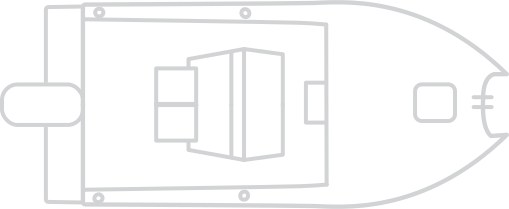
Twin hulls spread the boat’s weight across a wider surface area, dramatically reducing side-to-side motion. On a powercat you can stand at the bow in a chop without holding on. You can cast from the gunwale while your mate gaffs a fish off the stern. That kind of stability isn’t just comfortable — it changes what’s possible on the water.
A smoother ride in rough conditions
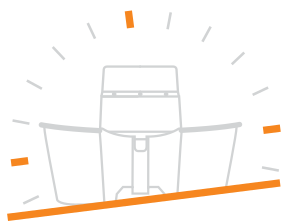
At speed, a powercat gains lift and cushioning from air and spray pressured between the hulls — the air cushion effect. Two narrow hulls slice through waves rather than slamming into them. The result is a drier, smoother ride than a monohull of similar size, particularly in the short steep chop that NZ coastal conditions are known for.
Twin engine reliability
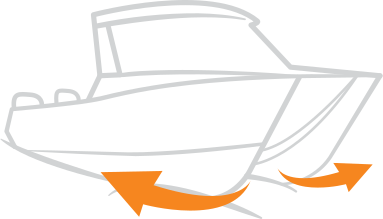
Lose power in one engine and you get home safely on the other — often still on the plane. Independent steering means you still track straight. Add independent fuel tanks and batteries and you have a level of redundancy that a single engine monohull simply can’t match. For offshore fishing, that peace of mind is genuinely valuable.
Better fuel efficiency once on the plane
With only 250mm of water displacement and two narrow hulls, powercats require less horsepower to get on the plane than their size suggests. Once there, they run efficiently — making them an excellent choice for long range fishing trips where fuel costs add up.
More usable underfloor space
On our larger models from the 730 up, the twin hulls mean two full underfloor areas — space that can be used for berths, tankage, refrigeration, and accessible storage. On a monohull, much of that space is wasted in the deadrise of a single V-hull.
Easy to beach, easy to haul out
Powercats with outboards sit flat on the beach — just drive them up and step off. In a boatyard, catamarans can be sat on blocks without lateral support, making haulouts straightforward.
Shallow draft
As little as 250mm draft means you can access beaches, bays and shallow anchorages that deeper monohulls can’t reach.
What are the downsides of a powercat?
The honest answer — the wider beam means some marina berths charge you for the extra width. And if you’re mainly fishing fast, narrow rivers, a shallow draft tinny will serve you better.
But for NZ coastal and offshore fishing — where stability, range, and rough water capability matter most — the powercat wins convincingly.
Still not sure? Get on one.
The only real way to understand what a powercat feels like is a sea trial. Get in touch with your nearest Kingfisher dealer and we’ll make it happen.